Showing posts with label sculpture. Show all posts

Tuesday, 21 October 2014

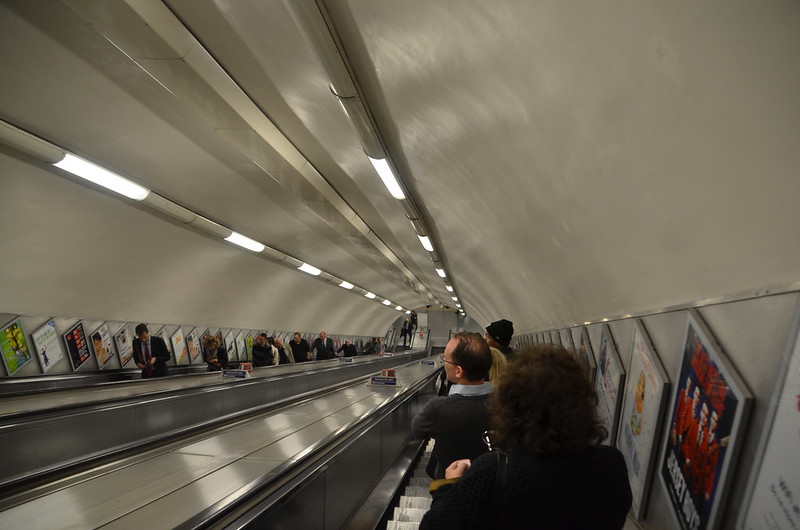
You go up the escalator, you go down the escalator. A multi-story escalator. In between, you catch some rays at Green Park. England Scotland Heritage Tour, 2014


I live with a fear of heights and motion sickness, plus a pair of 66-year-old knees. Guess where I went once I'd taken this photo, motion-sickness-acupressure-bracelets on each wrist? To the right to hold on for dear life so that this blessed escalator could take me up to street level. Our goal, to spend a few minutes in Green Park.


You see, when I got my first paying job after high school I bought a book with my first paycheck, a lovely, over-sized book filled with memorable photographs of London taken in the late 1960s. I lost that book somewhere, but I've always remembered a particular photo of Green Park. My photo is not a match for that one--it was in the trees, dappled sun and shadow. Mine, flooded with sunshine, shows you the Park Deckchairs, something I could have gotten in and out of back in the late 1960s.


There goes Juliet on the right, circling Diana of the Treetops, the combination sculpture and water fountain for people and dogs which was moved just outside the new Underground entrance in 2011. Originally installed elsewhere in Green Park in 1954 and sculpted by Estcourt James--Jim--Clack in 1951 after he won the competition to create a fountain  for the park, the gilding was added prior to the move to this location. The sculpture was commissioned by the Constance Fund, set up by Constance, widow of sculptor Sigismund C. H. Goetze. In his memory she wanted to "encourage and promote the art of sculpture in London parks."
DSC_0163

We didn't take time to walk out into the park since I was on a tight schedule--my solicitor friend Richard Taylor had invited me to be his guest at the Quit Rents Ceremony and I needed to meet him at 2:30 p.m. in front of the Royal Courts of Justice on The Strand which is within walking distance of our destination, Covent Garden. Now for the scariest part of the ride on London's world-famous Underground--the down escalator. Once again, I held on and concentrated on realizing that I would stay upright and make it to the bottom so we could jump on a train and make our way to Covent Garden.

Friday, 24 January 2014

Public Art, outside the Moda Center which used to be the Rose Garden--it's where the Portland Trail Blazers play NBA basketball


I took this photo at 3:06 p.m. on March 9, 2013, a particularly nice blue sky day for us. That's I-5 you see there behind The Little Prince. Those buildings are in an area known as the Lloyd District which is in Northeast Portland. One of these days I plan to be in good enough shape to walk there from my apartment. I'll take my camera and take photos to share with y'all!

In the past I've taken several other photos of this public art and have posted them on the blog. Click here to see four of them. In case you don't have time to click there to see the photos and read about the sculpture, I've copied and pasted the info for you here.

Bits I discovered online about the sculpture.

  • The Little Prince, by Ilan Averbuch. Copper and steel, 1995.
  • The Little Prince is a partially buried copper crown located at the south end of the arena in the Rose Quarter. It is a piece about imagination, desires and aspirations, conquests and struggles. It is the job of the viewer to create the story that goes along with the crown. Is it a victory and position of honor waiting to be claimed, or is there another story? Only the viewer can say.
  • Ilan's inspiration for this piece was the "Little Prince" by Antoine De Saint-Exupery, in particular, the first chapter where he talks about his drawing of a boa constrictor swallowing an elephant being misunderstood as a hat.
  • Ilan Averbuch's "Little Prince" and the Portland Trailblazer's Rose Garden Arena. Portland, Oregon . . . legend has it that the crown will be stood upright when the Blazers with their next championship.
  • The Little Prince, 1995, is a gigantic fallen crown, an image of a ruin of ancient majesty, of one-time splendor, and a version of another recurring theme in Averbuch’s work: the obsolescence of the monumental, former monuments in the soil, like ancient relics.
  • The Little Prince (Ilan Averbuch, 1996) is a copper crown, standing 15 feet tall in front of the Rose Garden. Inspired by the French children's story by Antoine De Saint-Exupery, the artist asks that you use your imagination to think of a story behind the crown. The crown is resting on its side perhaps waiting as a prize to be claimed or as a symbol of a triumph to come.

Friday, 20 September 2013

One more view of Running Horses, Tom Hardy, 1986, Bronze SW 6th and Madison, part of the Public Art on the TriMet MAX Green Line

Click here for a trip to City Daily Photo, transporting you around the world every day.

running_horses_5_PM

While looking for more public art photos to feature, I came across this one of Running Horses. I took it on Feb. 20, 2009. I've been racking my brain trying to figure out why the sun was shining like this and that flowering tree is blooming, plus the bloom on that shorter plant--I think it is a camellia--in February?

Confusing. So I've looked back at my blog and found a completely dry photo that I took on Feb.5, another one where a lady's sitting outside at an ice cream place, bundled up in her coat, but it's sunny, no rain. So, February 2009 must have been a less wet month than I would have thought, with enough sunshine and warmth to bring on the blooms.

Wednesday, 18 September 2013

Constellation, three sculptures by Tad Savinar, 2000, Bronze -- No. 3, A Neighborhood Gardener

Click here for a trip to City Daily Photo, transporting you around the world every day.

A Neighborhood Gardener. From the plaque at the park: "These three sculptures are a visual representation of the connections between our civic gardens and our neighborhoods, and of the pivotal role we have as stewards of those relationships." This project was funded by the City of Portland's Percent for Art Program, administered by the Regional Arts & Culture Council.
  gardener_1_PM

Garden shears in her right hand, she stands still, perhaps reflecting on her garden and the work she's accomplished. You can see her gardening gloves hanging from her left hip pocket in this photo. I found this description on the Internet: Standing female figure representing the neighborhood gardiner is actually a portrait of long-time community organizer, Carolyn Marks-Bax, who was selected for this honor by the neighborhood. I found it by accident, since gardener is misspelled.
  gardener_3_PM

I found on the Internet that the statue modeled after a local gardener, Carolyn Marks-Bax, who gardened near the park in the Sullivan's Gulch neighborhood. She may still garden there, I have no idea. When I go back some day to see this series of sculptures again, I plan to pay better attention to her.

Historical Information, from the City of Portland, about Holladay Park.

This park is named after Benjamin Holladay (1819-1887), known to many as "a sharpster, a con man, and a rake." He stirred things up wherever he went and was a bit of a dandy, dressing like a riverboat gambler. He was said to be "wholly destitute of fixed principles of honesty, morality, or common decency." In 1868 Holladay sold his stage coach business in California to Wells Fargo and moved to Portland to get involved in the railroad business. His goal was to build a rail line to California along the east side of the Willamette River. In order to do so, he spent a total of $55,000 in bribe money to help secure his company's endorsement. He also built two large hotels in the area where the park bearing his name is now located. Known as an extravagant spender, Holladay owned numerous mansions on both coasts and had over extended himself financially. He lost his railroad in 1876, and died in Portland in 1887.

Commissioned by the Lloyd Corporation and Pacific Power & Light in 1964, a concrete fountain featuring music and lights was installed in the park. Designed by Jack Stuhl, assisted by Ted Widing and Phillips Electrical, the musical fountain was favorite gathering place for park visitors. It was replaced in 2000, in conjunction with a major renovation of the park, by a spouting fountain designed by Tim Clemen and Murase Associates.

Three cast-bronze sculptures by artist Tad Savinar were added to the park as a percent-for-art project in 2000. Entitled Constellation, the project illustrates the connection between the personal front yard garden and the civic park garden through three distinct elements: a vase of cut flowers, an abstract molecule containing elements of a good neighborhood, and the figure of a home gardener, shears in hand. The objects in the molecule were selected by the Sullivan Gulch Neighborhood Association and the gardener was modeled after Carolyn Marks, a longtime neighborhood activist.

Tuesday, 17 September 2013

Constellation, three sculptures by Tad Savinar, 2000, Bronze -- No. 2, Flowers From a Neighborhood Garden

Click here for a trip to City Daily Photo, transporting you around the world every day.

Flowers From a Neighborhood Garden. From the plaque at the park: "These three sculptures are a visual representation of the connections between our civic gardens and our neighborhoods, and of the pivotal role we have as stewards of those relationships." This project was funded by the City of Portland's Percent for Art Program, administered by the Regional Arts & Culture Council.
  bouquet_2_PM

One view of the vase of cut flowers. I found this description on the Internet: A slender vase with a tall arrangement of flowers including hydrangeas and daisies.
  bouquet_1_PM

Another view of the cut flowers.

Historical Information, from the City of Portland, about Holladay Park.

This park is named after Benjamin Holladay (1819-1887), known to many as "a sharpster, a con man, and a rake." He stirred things up wherever he went and was a bit of a dandy, dressing like a riverboat gambler. He was said to be "wholly destitute of fixed principles of honesty, morality, or common decency." In 1868 Holladay sold his stage coach business in California to Wells Fargo and moved to Portland to get involved in the railroad business. His goal was to build a rail line to California along the east side of the Willamette River. In order to do so, he spent a total of $55,000 in bribe money to help secure his company's endorsement. He also built two large hotels in the area where the park bearing his name is now located. Known as an extravagant spender, Holladay owned numerous mansions on both coasts and had over extended himself financially. He lost his railroad in 1876, and died in Portland in 1887.

Commissioned by the Lloyd Corporation and Pacific Power & Light in 1964, a concrete fountain featuring music and lights was installed in the park. Designed by Jack Stuhl, assisted by Ted Widing and Phillips Electrical, the musical fountain was favorite gathering place for park visitors. It was replaced in 2000, in conjunction with a major renovation of the park, by a spouting fountain designed by Tim Clemen and Murase Associates.

Three cast-bronze sculptures by artist Tad Savinar were added to the park as a percent-for-art project in 2000. Entitled Constellation, the project illustrates the connection between the personal front yard garden and the civic park garden through three distinct elements: a vase of cut flowers, an abstract molecule containing elements of a good neighborhood, and the figure of a home gardener, shears in hand. The objects in the molecule were selected by the Sullivan Gulch Neighborhood Association and the gardener was modeled after Carolyn Marks, a longtime neighborhood activist.

Monday, 16 September 2013

Constellation, three sculptures by Tad Savinar, 2000, Bronze -- No. 1, Isolated Molecule for a Good Neighborhood

Click here for a trip to City Daily Photo, transporting you around the world every day.

Constellation: Isolated Molecule for a Good Neighborhood. From the plaque at the park: "These three sculptures are a visual representation of the connections between our civic gardens and our neighborhoods, and of the pivotal role we have as stewards of those relationships." This project was funded by the City of Portland's Percent for Art Program, administered by the Regional Arts & Culture Council.

First, photos of the atoms in the molecule, followed by a wide shot of the sculpture in Holladay Park, NE 11th Avenue & Holladay Street. At the end of the post you'll find historical information about the park and more details about the sculptures, from the City of Portland. I took these photos November 6, 2010.
  molecule_milk_carton_PM

Milk carton.
  molecule_school_milk_carton_PM

Milk carton and school building, front view.
  molecule_school_PM

School building, back view.
  molecule_garden_spade_house_two_story_PM

Garden spade and house, back view.
  molecule_house_two_story_porch_PM

House, front view.
  molecule_neighbors_PM

Family. Has something been broken off in the center of this group of figures? It's the turquoise color showing at the top of those structures that makes me wonder.
  molecule_wide_shot_PM

The entire sculpture, not the best angle for seeing it clearly, what with the nearby tree trunks being almost the same color. And I missed a few of the atoms: An enlarged structure of a molecule featuring atoms in the shape of a garden tool, a milk carton, a coffee mug, a bagel, a house, a school, a family, and trees --all the things that make a good neighborhood. Now I have a reason to go there again someday and take a longer look, see what else I can photograph.

Historical Information This park is named after Benjamin Holladay (1819-1887), known to many as "a sharpster, a con man, and a rake." He stirred things up wherever he went and was a bit of a dandy, dressing like a riverboat gambler. He was said to be "wholly destitute of fixed principles of honesty, morality, or common decency." In 1868 Holladay sold his stage coach business in California to Wells Fargo and moved to Portland to get involved in the railroad business. His goal was to build a rail line to California along the east side of the Willamette River. In order to do so, he spent a total of $55,000 in bribe money to help secure his company's endorsement. He also built two large hotels in the area where the park bearing his name is now located. Known as an extravagant spender, Holladay owned numerous mansions on both coasts and had over extended himself financially. He lost his railroad in 1876, and died in Portland in 1887.

Commissioned by the Lloyd Corporation and Pacific Power & Light in 1964, a concrete fountain featuring music and lights was installed in the park. Designed by Jack Stuhl, assisted by Ted Widing and Phillips Electrical, the musical fountain was favorite gathering place for park visitors. It was replaced in 2000, in conjunction with a major renovation of the park, by a spouting fountain designed by Tim Clemen and Murase Associates.

Three cast-bronze sculptures by artist Tad Savinar were added to the park as a percent-for-art project in 2000. Entitled Constellation, the project illustrates the connection between the personal front yard garden and the civic park garden through three distinct elements: a vase of cut flowers, an abstract molecule containing elements of a good neighborhood, and the figure of a home gardener, shears in hand. The objects in the molecule were selected by the Sullivan Gulch Neighborhood Association and the gardener was modeled after Carolyn Marks, a longtime neighborhood activist.