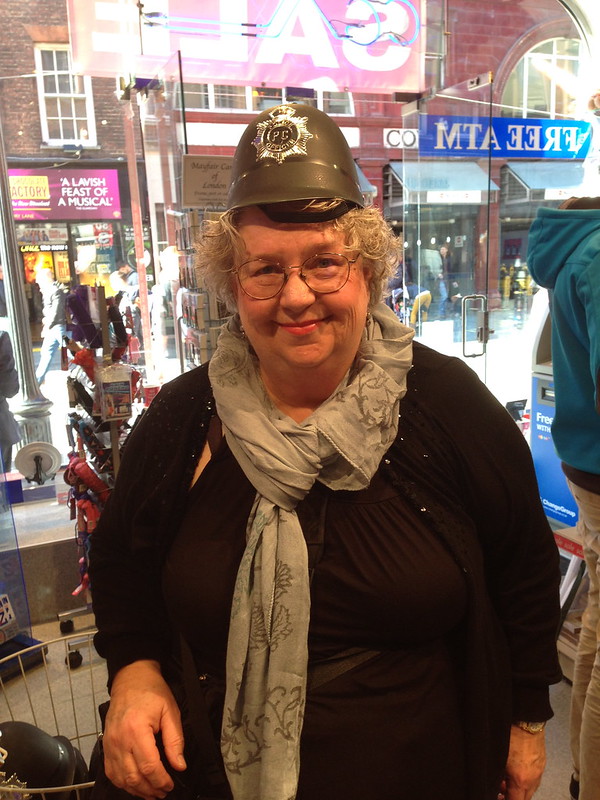
I shopped a bit on the street on the way to Covent Garden and, at Juliet's request, posed with this child's version of the iconic London bobby hat. I completely forgot to put this on the post yesterday--blame it on the doggone cold's hold on my brain. I'm feeling much better now and couldn't resist putting the photo on today's post. Thanks for putting up with my big ol' head, bobby hat strap sticking out like a sore thumb photo--some of you may have already seen it on Facebook when it was originally taken on October 7.
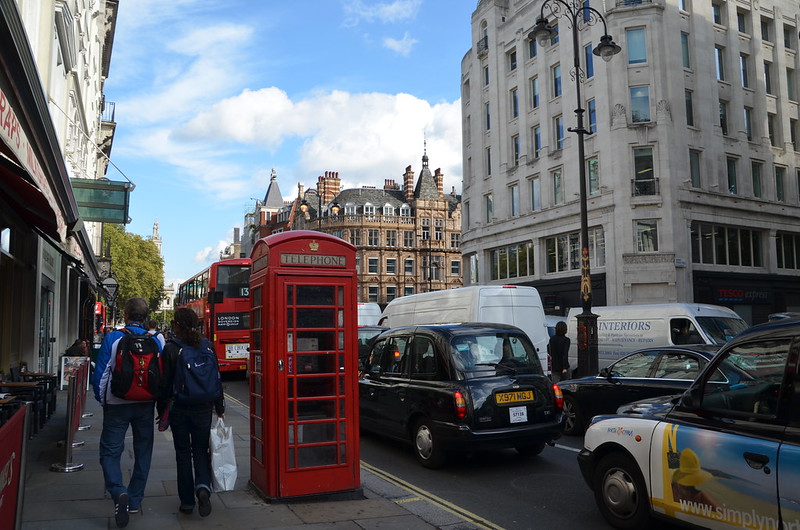
Once I had finished eating my scrumptious savoury crepe, I realized I had time to take a few photos along the way and still be on time to meet Richard. Ah, the iconic phone booth, seen on The Strand. And, yes, a double decker red bus, too! Serendipity!
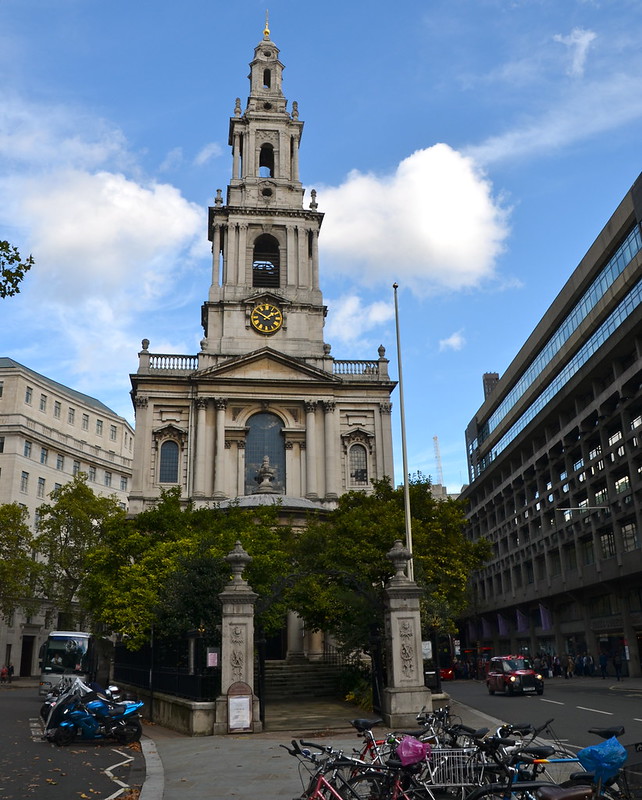
Next I noticed a church, in the middle of the street! St. Mary le Strand.
I hope you’ll have time to click here and read the fascinating details about this church on a traffic island.
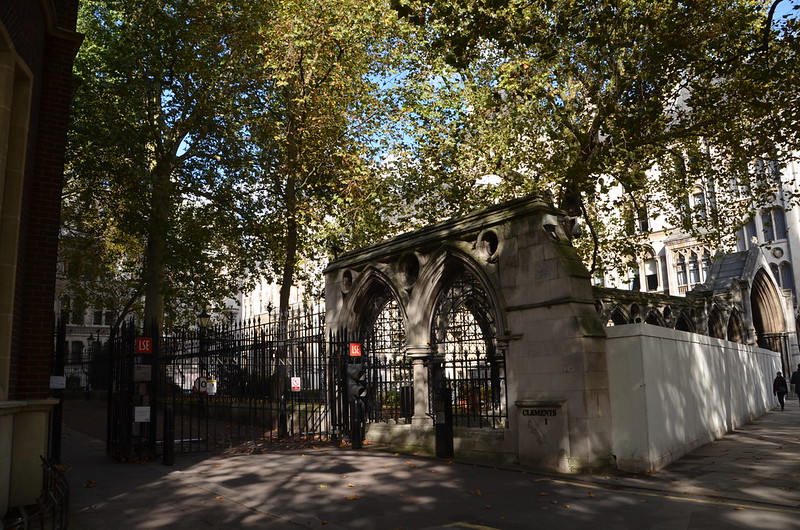
Almost there--I recognized the arches from having looked up the Royal Courts of Justice on Google Maps back home in Portland. I walked along the low white wall a few steps towards that huge building seen through the trees, looked across what seemed to be a driveway and saw Richard! Standing on the sidewalk in front of the building! I'm thirty minutes early for our appointed meeting time, and there he stood. Talk about your serendipity! I hollered, "Richard!" He turned and saw me, smiling as I approached. As he gave me a big hug, he said, "You haven't changed a bit, Lynette." I last saw this gracious gentleman in June, 2001.
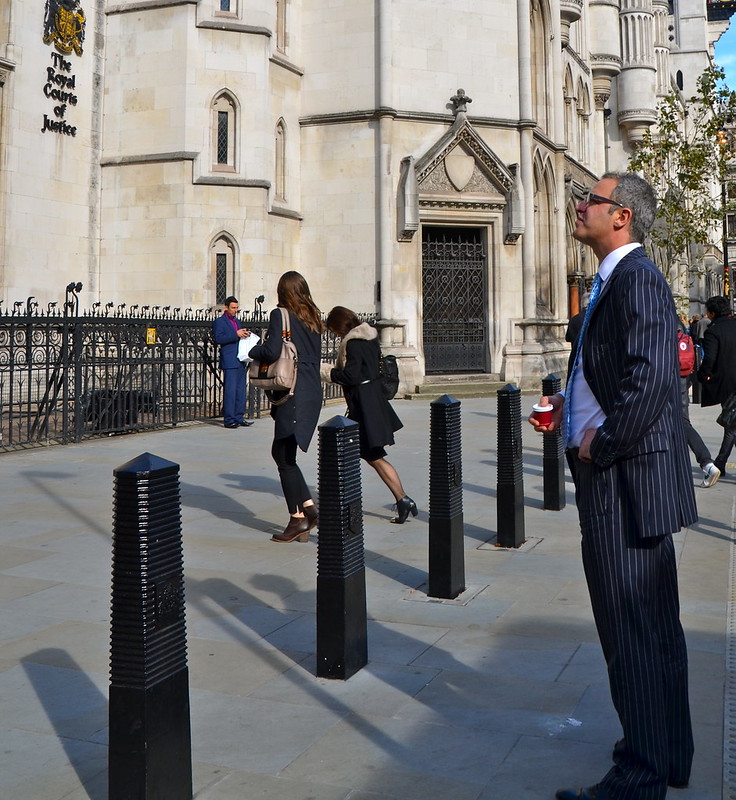
We sat down for a moment on a stone bench, facing the front of the building, both of us thinking about why we were about to enter it. Richard had been invited to speak at the Quit Rents Ceremony, and he'd invited me to be his guest. Simple as that. (Read more later about the ceremony--I wasn't allowed to take photos inside the building.) Richard stood up to take another look at the building, concentrating on his speech. I got this candid photo of him--hooray.
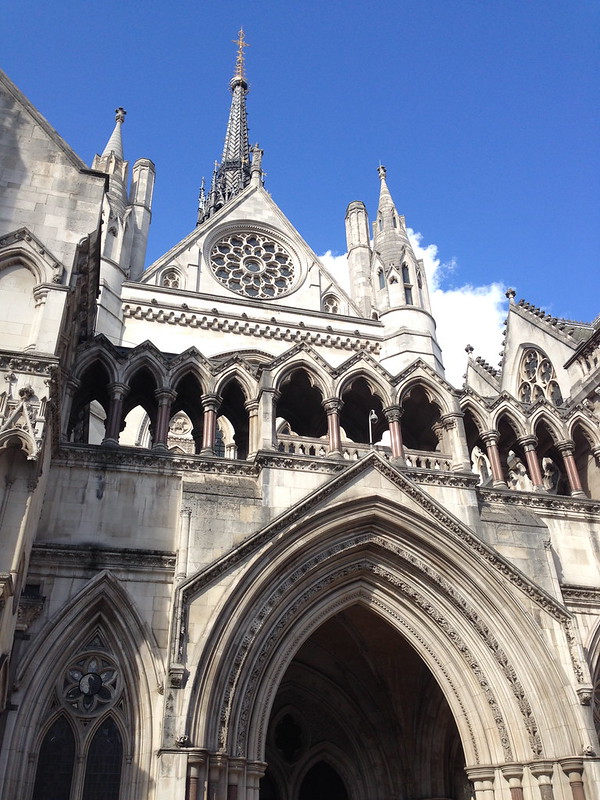
Above the main doorway--beautiful but so high up that it's difficult to get a good shot when you're five foot four inches tall.
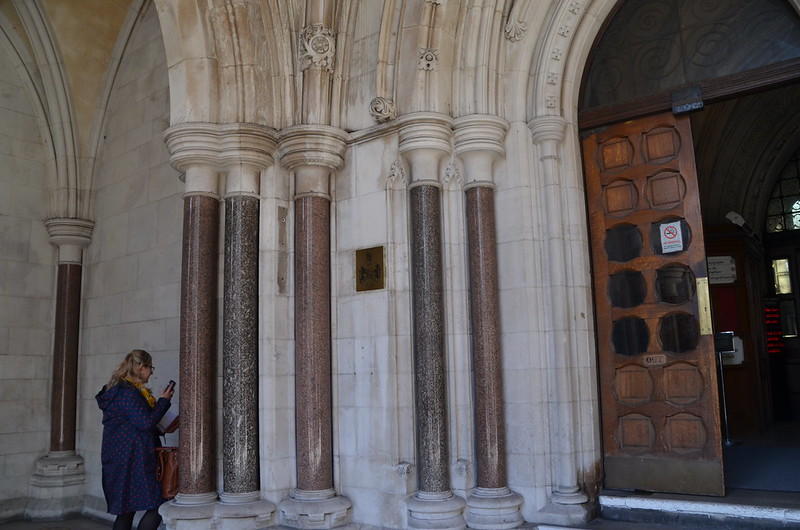
Here's the last photo I took before we continued through the open door. I'm turning off the camera, flipping shut the view screen, reading the NO photography sign. Inside waited a scanner machine and a man. He said, "Put your camera in your bag, madam. You use it, you will lose it." I quickly put it in my bag, assuring him I absolutely no intention of taking a photo inside the Royal Courts of Justice. I wasn't even tempted to take a photo throughout the entire ceremony, but, whew, I have to tell you, if I had been allowed to take photos, I'd have some of the coolest ever to share with you. Richard spoke after all of the ceremony, keeping everyone's attention very well, drawing some laughs and high praise by those who came up to him afterwards.
From the Royal Courts of Justice Web site:
Queen remembrancer: Origins
The Office of the Queen's Remembrancer is now the oldest judicial post to remain in continual existence since the Middle Ages - since the Lord Chancellor whose post predates that of the Remembrancer by some 60 years - has decided to renounce his judicial duties.
The Office originated in the Michaelmas Term of 1164 when King Henry II sent his senior civil servant, Richard of Ilchester who subsequently became the Bishop of Winchester, to the Court of Exchequer to help the Treasurer (now the Chancellor of Exchequer) supervise the annual collection of taxes. Richard was ordered to 'put the King in remembrance of all things owing to the King'.
Thereafter the King's Remembrancer attended all the sittings of the Court of Exchequer until it was abolished in 1882.
When the revenue functions of the Court of Exchequer ceased in the 1830's the King's Remembrancer assumed all the ceremonial duties of the Court and these were enshrined in various statutes such as the Queen's Remembrancer's Act 1859, The Sheriffs' Act 1887 and the Coinage Act.
The Queen's Remembrancer as the last surviving member of the old Court of Exchequer is required to wear on top of his full bottomed wig, the black tricorn hat of the former Cursitor Baron (judge) of the Court of Exchequer and is also the Custodian of the Great Seal of Exchequer which is the seal of Office of the Chancellor of Exchequer but is placed in the care of the Remembrancer.
The Queen's Remembrancer presides over two of the oldest legal ceremonies namely the Rendering of the Quit Rents to the Crown (1211) and the Trial of the Pyx (1249).
Quit Rents Ceremony
At the Quit Rents Ceremony the Queen's Remembrancer receives the newly elected Sheriffs of the City of London and gives each of them their Warrant of Approbation from the Queen of their election by the Livery of the City of London. This is also the occasion on which the Corporation of London present to the Court of Exchequer presided over by the Remembrancer, two 'services' to go quit of paying rent for two pieces of land now in theory held by the City.
One piece of land is known as 'The Moors' and is situated south of Bridgnorth in Shropshire. For this land the City present to the Court two knives, one blunt and one sharp. These qualities are tested by the City's Comptroller trying to cut through a hazel rod one cubit in length (19 inches) and the thickness of the Remembrancer's forefinger. The rod must merely bend over the blunt knife but must be cut through by the sharp knife for the City to 'go quit of paying rent' by the satisfactory performance of this service. The other service is for a forge formerly in Twizzers Alley just south of St Clement Danes Church in the Strand, London. This service is performed by the Comptroller producing to the Remembrancer six large horseshoes and 61 nails, which he must count out in Court before the Remembrancer pronounces 'Good service'. These ceremonies are some of the oldest legal ceremonies dating as they do from 1211 and 1235. The horseshoes date from 1361 when the tenant of the Forge was permitted to pay 18 pence per year provided she had these shoes made for use each year. They are probably the oldest set of shoes in existence. At this Ceremony, the chequered cloth from which the Court took its name is laid out on the Bench at which the Remembrancer sits. The cloth was used as a means for checking what was owed by each Sheriff who collected the taxes due from his County. Counters were placed on the right hand side to show what was owed and different counters were placed on the left hand side as the monies due were paid in. At the end of the day the two columns of counters should tally.


